
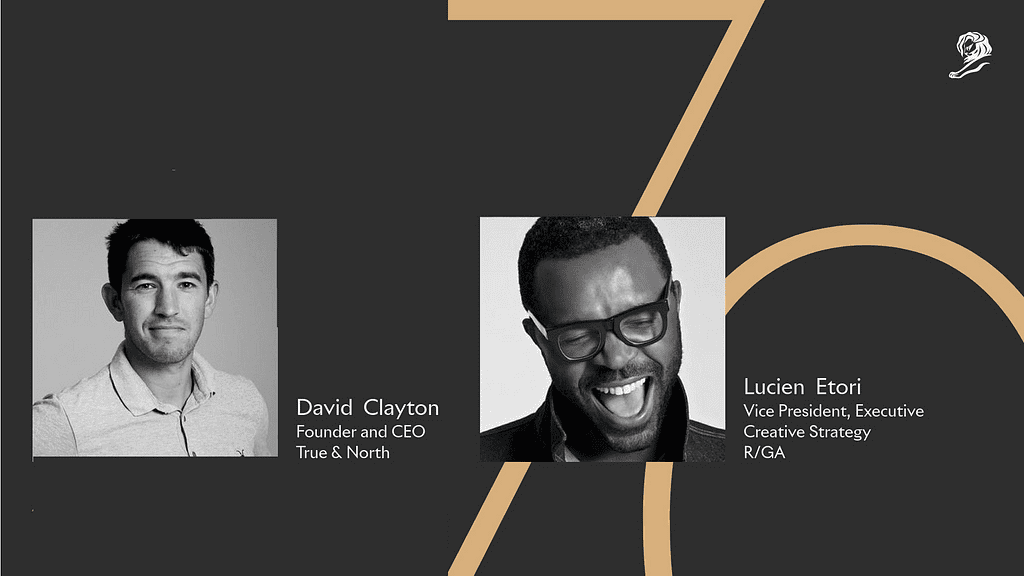
They own the stage, command attention, and inspire senior audiences across the Creative industries. But has it always been that easy for them, or have they had to learn the art of the pitch?
To find out, we sat down with the duo behind one of the most successful workshops at Cannes Lions 2023: A Masterclass to Confidently Sell Your Ideas.
Watch the Cannes Lions Session Highlights Here
Learn how to bridge the gap between a brilliant idea and a signed contract.
While the stage at The Lab may have been set back in June 2023, the insights shared by these experts have become the definitive roadmap for navigating the commercial pressures of 2026. In this interview, they pull back the curtain on nerves, the myth of the “born salesperson,” and why empathy is the ultimate competitive advantage.
Lucien Etori, former Vice President, Executive Creative Strategy at R/GA, has spent over 20 years building and growing brands — at the vanguard of creative, digital & marketing innovation for forward-thinking, industry-leading agencies.
David Clayton, CEO & Founder of True & North, empowers teams in leading Agencies, Media and Tech companies to shift their mindset to a client-centred culture by understanding clients deeply — solving problems with them more collaboratively — and delivering mutual growth.
1. Why is presenting our ideas so scary?
LE: It’s human nature! The word idea is a rather old Greek word that originally meant to see, so you can imagine what a peculiar challenge it is to try and convince people — with words! — to see what you see in your mind.
2. What’s the worst thing that’s happened while you’ve been trying to do your best sales spiel?
LE: You’re fired on the spot, security is called, and you’re escorted out of the building. While that has happened (not to me – thank god!), unsuccessful creative presentations are usually not as bad as they seem.
Sure, misreading the audience or taking the brief in a direction the clients are uncomfortable is never a pleasant experience. However, I never take it personally. I recall a couple of instances where the main client we were pitching simply got up after a few minutes and silently walked out of the room. It became pretty clear that our time was up.
DC: When I was pitching a PR firm opportunities in The Guardian. I went from hearing myself saying everything we’d planned to veering off-topic and being unable to pull it back. My partner in crime that day, Matt Race, was struggling to keep a straight face. I was bombing so badly.
Suffice to say, we didn’t close any business that day. And I got the piss taken out of me remorselessly back at the office. Ultimately, that’s the worst that can happen — you don’t close, and your workmates, quite reasonably, take the mickey. If you can handle that, you’re good to go.
3. Fear of being judged or ridiculed runs very deep for some people — can you get over it?
LE: Some people will never get over it because it’s so deeply rooted in social anxiety. Therefore, you can’t simply train yourself out of it. Glossophobia (fear of public speaking) affects 75% of people in the US. This means over 200M people are freaked out about speaking in public for fear of being judged or ridiculed. It is critical to give everyone the tools to understand why they’re fearful and how they can begin to address their concerns.
DC: Here, here. We’re mostly all a little scared to speak up in public. So, use that to ground yourself. You’re not alone, and you’re not broken. Most people are just as frightened as you. Prepare as best you can; you’re meant to be a little scared.
4. What are your thoughts on this notion that feeling nervous about your work is a natural part of the creative process?
LE: If you’re not nervous, your idea isn’t disruptive, bold or provocative enough.
DC: I want to feel nervous! Indeed, if I’m not nervous, it’s the biggest signal I don’t care enough, and things might go south if I don’t get my head straight.
5. What characteristics do the people most successful at selling their “non-no brainer” ideas have in common? And are these things which the rest of us can learn?
LE: You need a certain amount of courage to sell anything successfully. In my experience, the most successful are the ones who can not just sell an idea but tell a story where the idea is one of the main characters.
DC: If you genuinely believe in what you have to offer and want the client to succeed, that will shine through. Better yet, it may come through with passion or enthusiasm, which is contagious. When you believe, it’s tough for others not to want to get on board.
6. One topic the workshop covers is confidence — where do you stand on being confident versus faking it till you make it?
LE: I have faked it earlier in my career! It’s a dopamine rush, but it generated so much anxiety afterwards that I figured going into a presentation as my authentic self was better. Feeling confident in my command of the material and understanding that my audience was not looking to tear me down gave me pretty unshakeable confidence.
DC: Clients don’t want you to fail. In fact, their biggest fear is that what you have to say is irrelevant and they will waste their time with you. Don’t fake it. Prepare and show up with something thought through that you believe in. Then, win or lose, you can do so knowing that you did everything in your power.
7. You argue for a method based on empathy and mutual understanding — have you met any real salespeople?
LE: I know some amaaaaazing salespeople across much every industry you can think of. For instance, one of my friends sells frozen tomatoes from Spain. They all have the same unshakeable confidence you need to be successful. They are also great listeners and can pick up on the minor details of a conversation.
DC: I remember a learner at a large media agency saying, “My boss keeps telling me to stop selling!”. Clearly, people’s perception of sales is confused. The image is, sadly, of a used car salesman talking at us, trying to push us into something we don’t need. This person meant, “My boss wants me to stop talking at clients, pitching product after product, and to start helping the client get where they need to be”.
8. What does empathy mean in the context of selling ideas?
DC: Good ideas start from understanding the people you’re designing for. As a consequence, empathy for them (the user) is fundamental. What gets forgotten, however, is that you also need empathy for the people you’re selling the idea to. With empathy, you can position your idea in a manner that’s right for them. And, in turn, make it easier to understand and more likely that they’ll want to say yes.
9. How do you bring these ideas to life in the workshop?
DC: In Client-centred Thinking, we first re-centre people’s thinking on their client using an Empathy Map. This is a simple ethnographic tool that helps you see people holistically and understand their context. By approaching a sales opportunity from the client’s perspective first, you’ll spot a broader set of ideas and be able to articulate them in a way that’s more likely to resonate.
10. In marketing and advertising, a lot of focus around presenting is on being slick and using a bit of showmanship. What role does personal authenticity have in your method?
LE: It plays a determinant role if you want to make a MEMORABLE presentation. While anyone can have slides full of great insight. Still, when they’re delivered in an authentic way, that content will be a lot ‘stickier’ as people will associate YOU with the content.
DC: Showmanship/pitch magic is such a distraction. In Client-centred Thinking, we help people get the strategic rigour in place first. And then layer in the human side, like communicating in a way that feels authentic and is in line with how the client likes to receive information.
Some people, for example, want bullet points or quantitative data, while others what prose, performance and big ideas. So we must balance what’s authentic for us and how the client’s mind works.
11. You’re also big advocates of using academic disciplines to be better at selling — what’s behind this?
DC: Our raison d’etre is to enable anyone to have fantastic client conversations. On one extreme, we find people who see themselves as great sellers. On the other, people who are Creatives, Technologists, or Accountants and would run a mile if you said come and learn about sales.
Therefore, engaging people through something true for sales but transportable and interesting, like Behaviour Economics or Design Thinking, cuts through better and sticks for longer.
12. We’ve taken your workshop and gone in with a confident, empathy-based pitch, and they STILL shot us down. What’s your best first-aid tip for our wounded egos?
DC: It’s mindset + numbers. Hearing ‘no’ isn’t being shot down, but that you can move on without wasting more time. Instead, you can now focus your efforts on people who are likelier to say ‘yes’.
Furthermore, a ‘no’ usually means you’ll learn something too. Why you’re not a good fit and how you should adjust to be more relevant.
Lastly, they better not be your only conversation. A healthy pipeline makes it easier to take the loss and for a better night’s sleep too!
13. While we’re on that topic, what are your tips for helpful, empathy-based feedback we can use when it comes to other people’s creative efforts?
DC: I don’t have much experience here, but with any feedback, be thoughtful. Remember they put much of themselves into this, so be kind.